
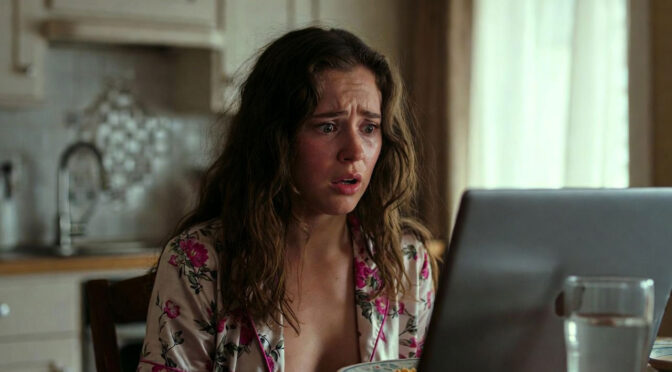
Deepfakes are a new technology, but an old form of violence. The body becomes material. The face becomes a mask. And the gaze of others becomes the authority that determines who you are. When we talk about eroticism in creative writing at this point, that is exactly what we are talking about: direction of gaze, communication, emotions that a particular situation evokes.
Nudity vs. incapacitation
Deepfakes do not begin with an intimate situation, but with access. The difference is crucial. Nudity can be a voluntary decision. A deepfake is an assertion without consent. The image does not say, “She is showing herself.” It says, “This is who she is.” And that is precisely the transgression: interpretive authority.
The damage before the question of authenticity
Many debates revolve around questions of proof: real or fake? For the person affected, this is often secondary. The core damage occurs beforehand. Your own face circulates in a context you did not choose. Your body becomes public without ever having been shared privately. You suddenly exist as a version you cannot control.
The decoupling: Me here, image there
Deepfakes separate identity into two levels. There is the living body with breath, warmth, nervousness. And there is an image that pretends to be that body. This division can be made visible in the text without spelling out the fake. One sentence is often enough to name the violence. After that, the focus is where it has an effect: in the perception of the character.
Shame as a reflex
In such situations, shame rarely feels like a thought. It feels like a reflex. Shoulders up. Chin down. Hand in front of the lower abdomen. An impulse to “cover” the chest and vulva, even though no one else is in the room. It is precisely this body language that is powerful in literature because it shows that the gaze of others is not only social. It is embedded in the nervous system.
The audience is infinite
An audience in a room is limited. A digital audience is potentially endless. It can return because screenshots return. It can grow because links are forwarded. And it can remain silent, which is often even worse. Silence here does not mean respect, but uncertainty. Who has seen it? Who thinks what? Who is silent and why?
Why comments are the wrong camera
Of course, one could depict chats, mockery, reaction GIFs, quotes, and distribution channels. The problem is not that this would be “too harsh.” The problem is narrative: the text then begins to replicate the perpetrator’s gaze. It builds up the audience instead of exposing the mechanics of the assault. It usually has a stronger effect to “reduce” the crowd and ‘intensify’ the pressure: on a body that feels observed.
The erotic reference: Naked without a scene
This is where we connect to our topic “Eroticism in Creative Writing.” Eroticism is about how nudity arises: through decision, through trust, through timing, through eye contact, through boundaries. Deepfakes turn this around. The character is made naked without any of that happening. That’s not “more explicit.” It’s “zero consensual.” And it’s precisely this difference that needs to be the focus.
Craft: Fake short, effect precise
If you describe the fake in detail, you get a paradoxical result. You want to criticize violence—and at the same time you deliver the most vivid scene precisely where the character has no authorship. That’s why a different approach works better: briefly describe the image (so it’s clear what it’s about) and then show in detail what it triggers in the character. This is not censorship, but visual direction.
Ways to respond: Regaining control without exposing yourself
The first approach is legal and technical. Secure evidence, report platforms, submit deletion requests, seek legal assistance, consider criminal charges. This is not “unpoetic.” It is part of reality. And it can work as a sequence of actions in the text because it gives the character a series of decisions to make: collect, document, name, intervene.
The second approach is social. The character builds a network that does not gawk, but protects: friends, colleagues, family, a clear circle that is informed before the rumor enters the room. Often this is the decisive scene: not the moment when “everyone” sees something, but the moment when the character calls the first person and says, “This is fake.” This brings shame out of isolation.
A third way is communicative. A short statement, a sentence, a framework. Not as a justification, but as a marker: “That’s not me.” Or: “That’s fake.” Some figures deliberately choose brevity because they don’t want to give the deepfake a stage. That, too, is authorship.
A fourth approach is artistic – without nudity. The figure can transform the attack into work without actually showing their body: an exhibition about manipulation, portraits with painted-over faces, texts in which image and person fall apart, audio works in which voice and body are decoupled. The theme remains the same core: Who owns an image? Who owns meaning?
All these paths are recapture. And for many, they are the obvious, safe first choice. Not every victim wants to put their body on public display to refute a deepfake. The text should make this range visible, because otherwise the same pressure is unintentionally reproduced: Show yourself, or it will be considered true.
Why real nude photos are a radical option – and when they make sense in the text
Real nude photos only work as a counter-movement if it is clear what they are not: no obligation to provide proof, no duty, no “this is how you solve it.” They are an extreme measure because they open up a second threshold: the figure voluntarily exposes herself to a visibility she did not want before. She takes a risk in order to regain control.
Dramatically, this is powerful when the text shows that this step does not arise from conformity, but from direction. The character does not decide because she has to explain herself, but because she wants to reframe the view. She determines the setting, the frame, the pace, the concealment, the boundaries. She can leave her face out, leave scars visible, cover or show her vulva, depending on what “real” means to her. This is not a response to the crowd. It is a decision against dispossession.
The threshold: becoming naked in front of a stranger
When the character contrasts the deepfake with real nude photos, it is not a simple gesture of “courage.” It is a second nudity, this time real, this time risky. And it is shameful for a reason other than sex. The photographer is not an intimate person. She is a stranger. She looks professional. This is precisely what makes the situation psychologically interesting: the character not only has to show skin, she has to define control.
Herein lies a powerful dramaturgical possibility: boundaries as concrete parameters. Face yes or no. Breasts yes or no. Vulva visible or concealed by pose. Light hard or soft. Looking into the camera or past it. Pauses, stop signals, clothing in the room. Every decision writes authorship back into the body.
Example scene: The path to reconquest
She finds the link in a message without a salutation. A preview image, her face. A click that feels like stepping on thin ice.
The image shows nudity as if it were a fact. Nipples in the light, belly, pubic area between open thighs. Everything is so clearly composed that it feels like a judgment. And yet something is wrong. Her face seems too smooth. The expression does not match what she knows of herself. The eyes are hers—but without her gaze.
She sits at the table fully clothed and notices how her body still feels “naked.” Her hand wanders to her lower abdomen, as if she had to cover her vulva. Her shoulders hunch up. Her breathing becomes shallow. Shame comes not as a thought, but as a pose.
Later, in the studio, she writes down times and saves links. It feels like she is collecting evidence of herself. Then she types a message to a photographer whose work she hardly knows. Three sentences. No drama. Just a question about boundaries and control.
On the day of the shoot, the studio is bright and neutral. The photographer is friendly but not familiar. A stranger who looks without taking. The artist wears a coat over her underwear. Even undressing becomes a threshold. The coat falls from her shoulders, then the shirt. She feels cool air on her skin. Her body reacts with the old reflex: protect her chest, pull in her stomach, hand towards her pubic area.
“We can stop at any time,” says the photographer. “You set the pace.”
When the bra is unfastened, her breasts move with her breath, heavier than the fake ones, more alive, imperfect in the literal sense: not as an ideal, but as reality. One breast slightly different from the other. Under the left breast is a fine scar that never existed in the fake. That’s exactly the point. The real thing isn’t “more beautiful.” It’s hers.
When she also slips off her panties, everything becomes very concrete. Vulva, pubic hair, inner thighs, warmth between her legs. Not an erotic act. But an intimate situation because it is deliberate. The photographer asks: Look at the camera or past it. Hands in front of the lower abdomen or at the sides. Knees open or closed. Each option is a small surrender of control.
Weeks later, she hangs the pictures in an exhibition. On the left are her real self-portraits, chosen by her, framed by her. On the right are the deepfake frames, small, pixelated, crossed out, with a clear label: Fake. Assault. Not my body. The audience has to make an effort to “see” anything at all. And that’s exactly how they finally see what’s real: not skin, but mechanics.
Underneath her real pictures is a sentence: “What you saw claims to be me. These pictures show me.” Then another: “A body is not material. Showing it is a decision.”
What makes this material erotic – without feeding the perpetrator’s gaze
Eroticism here arises not through explicitness, but through crossing a threshold. Through the moment when someone says: I am reclaiming the authority to interpret my body. I determine the framework. I set visible boundaries. And I stand in my body as it is, not as a mask, not as a claim.
This is not a digression from the topic. It is a radical clarification of what erotic literature always revolves around: What does nudity mean and how does it feel?