
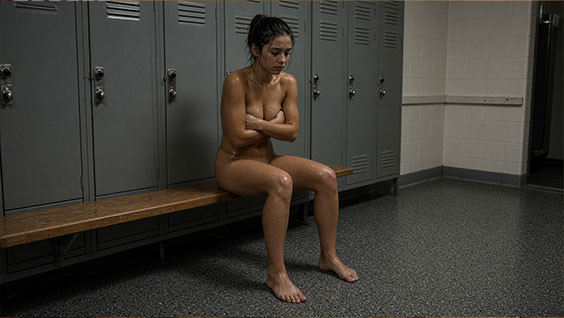
Pranks are generally considered harmless fun, a lighthearted game among friends or within a group. In erotic literature—and especially in the ENF (Embarrassed Nude Female) subgenre—they can, however, take on a different quality. What begins as a test of courage, a joke among friends, or a planned surprise can, within a matter of days, place the protagonist in a situation where she finds herself involuntarily and unexpectedly naked: without clothes, without protection, and without the ability to end the situation immediately.
For me, as an author of erotic literature, the appeal lies precisely in this transition. The prank provides an elegant mechanism for linking control and loss of control. The character has (seemingly) gone along with a game or trusts that the others know the boundaries. Then the boundary shifts—often just a little, but sometimes so far that the shame suddenly becomes real and physically palpable. Blushing, trembling, the automatic urge to cover up, the inner voice counting how many seconds remain until the next door: all of this becomes more important in ENF texts than the nudity itself.
In this article, I examine how pranks can create such moments. I present a series of possible scenarios and ask how they tap into the specific potential for ENF readers—that is, those readers who are less interested in mere exposure than in the prolongation of the embarrassment, the character’s reaction, and the question of what happens to them afterward. I’ll also provide examples from (largely niche) literature that works with this motif. Finally, I’ll take a look at how rewarding it is to explore this topic from an economic perspective—both for authors and for the niche itself.
Because a good prank in ENF doesn’t end with bare skin. It begins there.
Scenarios and Their Dramatic Potential
Pranks in ENF rarely work as isolated gags. They thrive on escalation and reaction. Here are a number of scenarios that have proven effective in practice—and how they make the most of the genre:
- The Towel or Shower Prank (a classic with high intensity): The protagonist is in the shower or just stepping out; friends or roommates hide her clothes, pull the towel away, or lock the door. Her first impulse is panic and to cover herself instinctively. The potential lies in the prolongation: She has to walk down the hallway, across campus, or to a neighbor’s apartment—and encounters other people along the way. The embarrassment isn’t just observed; she has to actively navigate it. For ENF readers, what counts here is the microphysics of embarrassment: the trembling of her hands, the attempt to make her voice sound normal, the inner voice calculating how many seconds remain until the next door.
- The Party or Dare Escalation: What begins as “Truth or Dare” or a harmless bet is escalated by a group or a single ringleader. Clothing is removed piece by piece, or an item of clothing is “accidentally” rendered unusable (e.g., by water, paint, or a pre-cut seam). The appeal lies in the social dynamics: The protagonist doesn’t want to come across as a killjoy while the others are already moving on. The potential for ENF lies in the dual exposure—naked in front of the others and internally torn between the desire to play along and the desire to disappear. It’s particularly effective when the character realizes that the others have been planning the prank for longer than she thought.
- The public or semi-public prank (beach, park, festival, campus): Clothes are stolen while the character is swimming or changing; a bikini comes undone; friends send her off with a false message and take her bag. Here, private shame becomes public. The dramatic potential lies in the impossibility of ending the situation quickly: she has to cover some distance, make decisions (hide or run through?), and every outside gaze intensifies her inner conflict. ENF readers often appreciate precisely this prolongation—the moments when the character still believes she’ll remain undetected, only to be seen after all.
- The “friendly” or trust-based prank: A close friend or roommate takes advantage of the trust (a package at the door, “just holding the towel for a second,” changing clothes together). The breach of trust intensifies the shame because it is not only embarrassing but also personal. At the same time, it opens the door to later plot twists: The friend can resolve the situation, escalate it, or prompt the protagonist to take control of her own shame. This is narratively fruitful because it changes relationships.
- Initiation or group pranks (sorority, team, clique): The prank is part of an initiation or ritual. It appears legitimized by the group and is therefore harder to refuse. Here, the scene can shift from pure ENF toward transformation: The shame remains real, but at some point the character decides not just to endure the moment but to make use of it—or she realizes that the group retains power over her visibility. This corresponds to what we’ve described elsewhere as a dramaturgical turning point: from the object of circumstances to the subject who reinterprets the gaze.
In all these cases, the scenarios fully realize the ENF’s potential when they do not stop at mere nudity. Crucial elements include the physical signs of shame (blushing, breathing, the futile attempt to cover up), the internal monologues, the delay in resolution, and the question of what the character does with the experience afterward. A prank that ends after three paragraphs wastes the material. A prank that forces the character to live with the exposure—even if only for half an hour—gives the reader the space the genre requires.
Examples from Literature
Pure ENF literature is predominantly a niche phenomenon and is found primarily in online communities and in self-publishing. Nevertheless, there are clear examples that work with pranks:
On Literotica, you’ll find stories like “A Prank Too Far” (clothes are stolen, and the protagonist has to walk through school naked) or “Sara’s Embarrassing Morning” (teammates steal her clothes after practice). Both use the classic mechanics of the shower/locker room prank and stretch the situation across multiple locations and encounters. On Lush Stories, there’s “Tricked By My Best Friend,” in which a roommate repeatedly uses a towel and a door to trick the protagonist, eventually drawing her into a party scenario where she’s aware of her own ENF fantasies—yet is still caught off guard by reality. This is where the meta-level gets interesting: the character knows what the genre expects, yet is still caught off guard.
In the self-publishing sector (Kindle), there are titles like Ada Watson’s “Naked Prank,” in which a disintegrating bikini is part of a sorority initiation. The story plays on the public dimension and the surprise that modesty can be not only embarrassing but also arousing—a tension that many ENF texts deliberately leave open.
Similar patterns can be found in German-language online erotica, for example in stories where female friends “forget” the protagonist after a shower or during an outing, or remove her clothing. Classic high literature rarely delivers pure ENF with prank-like mechanics; however, elements of involuntary exposure and social shame do appear in erotic texts that deal with power and the gaze (such as in certain passages of The Story of O or in more recent New Adult texts that explore initiation and group dynamics). Our own work set in sorority settings draws on related themes: Exposure is rarely purely accidental but rather part of a staged scenario that forces the character to reposition herself.
These examples show that the prank works literarily above all when it does not end as a mere gag. The best texts treat it as a threshold: the character loses control, and the story asks what she makes of it—or what the others make of it.
Economic Perspective: Is It Worth the Effort?
From an economic standpoint, the topic is worthwhile, but with clear limitations. ENF is a niche within erotic fiction. This means: a smaller absolute reach than general romance or dark romance, but a very loyal and affluent target audience that specifically seeks out certain tropes. On platforms like Literotica, Lush Stories, or in specialized subreddits and Discord communities, there is already a readership actively seeking pranks, dares, and involuntary exposure. Self-publishing (Kindle, personal websites, Patreon, newsletters) allows authors to reach these readers directly, without a mainstream publisher diluting the shame dynamic.
The advantages are obvious: repeat readers, high engagement rates for series and collections, and the ability to create entry points with relatively manageable effort (short to medium-length stories or novellas). Those who master the art of storytelling—that is, who describe not just the nudity but also the psychological and social aftermath—can set themselves apart from the mass of purely fetish-oriented texts. This increases the chances of reviews, recommendations, and repeat purchases. At the same time, there are risks: Platforms like Amazon have removed erotic titles in the past without clear justification (an experience we’ve had ourselves). Relying exclusively on a single platform leaves you vulnerable. Diversification (your own website, newsletter, other stores) therefore makes sense.
In the long run, this approach pays off especially when the topic isn’t treated in isolation but is woven into other elements: character development, relationship dynamics, and believable settings (campus, sorority, group of friends, workplace). Then a fetish scenario becomes a story that works even outside the narrowest niche. The demand for well-written ENF texts with erotic elements is real and stable; competition from high-quality, dramaturgically well-crafted texts is manageable. For authors who are willing to take shame seriously—rather than treating it merely as a gag—the field remains open and economically promising—especially if they build long-term reader loyalty rather than simply catering to them once.