
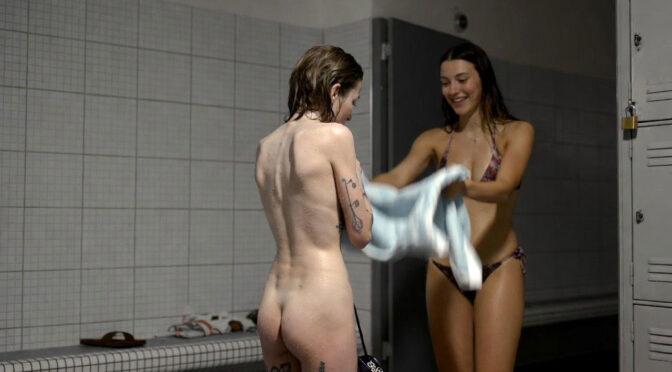
The ENF (Embarrassed Naked Female) genre focuses on scenes in which female characters find themselves in embarrassing, naked situations. Their job is to create tension and excitement through something we are all familiar with: the shame of being seen naked. Members of the LGBTQ+ community experience this shame just as much as cis women do. And just as with them, the question arises: How do we avoid reproducing the classic “male gaze”?
The male gaze, a concept from film and media theory, describes the objectification of women through a heterosexual, male lens that focuses on visual stimuli without taking into account the inner worlds of the characters.
In this blog post, I’ll give you practical tips on how to write ENF scenes that are authentic, respectful, and, above all, come from a queer, female perspective. The goal is to make the scenes empowering and consensual, rather than turning them into a mere spectacle for a male audience. Let’s get started!
1. Choose the right perspective: Tell the story from the inside out
The male gaze often arises from an external, observant viewpoint that describes a woman’s body as an object. To avoid this, write your ENF scenes from a first-person perspective or a third-person perspective that is closely tied to the thoughts and feelings of the characters involved. Focus on the inner world: How does the embarrassment feel? What emotions—shame, arousal, humor, or empowerment—play a role?
Example: Instead of “Her perfect curves glistened in the light as she stood naked” (classic male gaze), write: “My heart raced as my clothes fell away—not out of shame, but out of the exciting idea that she saw me like this, vulnerable and yet strong.” This makes the scene personal and queers it by emphasizing the relationship between the characters.
2. Integrate conflict and real dynamics into relationships
Stories thrive on conflict – the exciting question is how protagonists deal with and resolve these conflicts. The LGBTQ community naturally experiences the same everyday situations as cis-heterosexual people, which can lead to embarrassing ENF moments: bets, pranks, games like “truth or dare,” challenges, accidents or coincidences, medical examinations, massages, body searches, initiation rites, hypnosis sessions, magic, or even nightmares.
The point is not to attribute a whole set of problems to LGBTQ people, but first and foremost to show them as normal people with normal psychological reactions—shame, arousal, humor, or frustration—that are universal.
Tip: Use these conflicts to deepen the tension of embarrassment, but keep them authentic and respectful. Show how the characters deal with the situation: Perhaps a conflict arises from a prank in a group of lesbian friends, which is initially uncomfortable because old insecurities come to the surface, but through communication and mutual support leads to understanding and closeness. Or a bi character in a pansexual group loses a bet and ends up in a naked challenge that evokes real emotions such as vulnerability—and she resolves this by setting boundaries and reversing the dynamic.
Avoid creating conflicts based on coercion or lasting harm—this would reinforce the male gaze. Instead, let the characters take action, identify conflicts, and resolve them to portray queer relationships as complex but human. This way, you reflect reality without idealizing harmony.
3. Avoid stereotypes and objectifying descriptions
The male gaze loves to reduce women to their physical attributes—perfect breasts, narrow waists, etc. In queer ENF scenes, you should celebrate diversity: write about bodies of all shapes and sizes, with tattoos, scars, or disabilities. Don’t just describe the exterior, but how it feels to be touched, or how the partner’s gaze increases arousal.
Example: A pansexual scene in which a character with tattoos and scars loses her towel in a clumsy accident and her lesbian partner helps her – the focus is on the giggling, the touching, and the growing attraction, not on idealized body parts.
Use sensory details beyond the visual: smells, sounds, touch. This makes the scene more immersive and less voyeuristic.
4. Integrate humor, empowerment, and queerness
ENF can be funny! Use humor to defuse the awkwardness and make the characters stronger. In lesbian or bi scenes, this could mean that the person affected turns the situation around and gains self-confidence from it. Show queer dynamics: consensual power play or scenes that turn gender roles upside down.
Tip: Let the characters reflect: “Great—I’m standing here like a living work of art, while everyone else looks like they just ordered their coffee and didn’t forget the dress code.” She feels the stares, but instead of ducking, she lifts her chin: “If I have to do this, I’m going to do it with style.” The heat in her cheeks is not just embarrassment, but also a small, rebellious smile. This contrasts with the male gaze, which often portrays women as helpless.
5. Research and sensitivity: Learn from queer voices
Before you write, read works by queer authors such as Audre Lorde, Alison Bechdel, or contemporary erotic fiction by Sapphic writers. Ask yourself: Would this scene excite and empower a lesbian, bi, or pan reader, or does it feel like it was written for a heterosexual man?
Test your writing: Share it in queer communities (with consent) and listen to feedback. This will help you avoid unconscious bias.
Queer ENF as a space for authenticity
Writing lesbian, bi, or pan ENF scenes without the male gaze means shifting the focus from objectification to emotionality, consent, and diversity. It’s about stories that celebrate queer women and center their perspectives. Give it a try—your readers will appreciate it!
Do you have your own tips or experiences? Share them in the comments!