
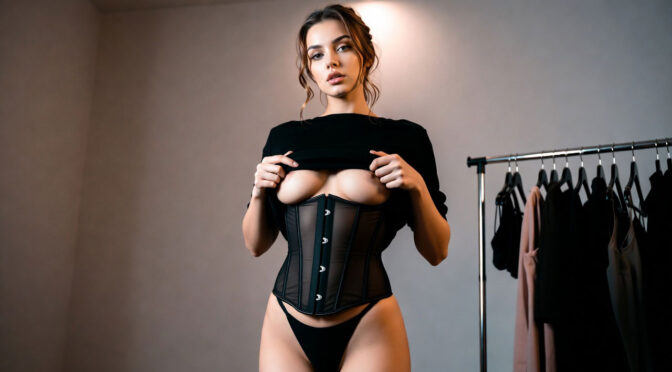
Underwear has long been an “invisible infrastructure”: it was supposed to support, smooth, not irritate, not stand out. In 2026, things will be different. Lingerie is becoming both more comfortable and more visible. It is designed to be part of the outfit – not a secret underneath. Added to this are two forces that do not contradict each other, but drive each other forward: comfort (because it’s everyday wear) and presentation (because it’s identity).
What this means in concrete terms: more soft constructions without rigid underwires, more lace and mesh that show skin but cover it in a targeted way. More colors—even deliberately “incorrect” combinations. And more material awareness: recycled lace, organic cotton, well-designed fasteners, straps, and back solutions.
Trend 1: Soft Structures—the new support doesn’t feel like support
The most important shift is unspectacular and therefore massive: your bra shouldn’t remind you all day long that you’re wearing a bra. Fewer hard underwires, more flexible construction, more “seamless” (barely any seams), more soft cups that support the bust without pressing it into shape.
Mini scene:
Morning in the bathroom. The window is fogged up, the tiles are cold. She doesn’t reach for the push-up bra that lies in the drawer like a tool. She takes the soft, low-seam bra. Fabric that fits snugly against the chest without cutting in. The straps lie flat on the shoulders, no metallic pressure. The cups are light—light enough that her nipples don’t show through her sweater as hard points, but not so thick that her body looks “wrapped up.” She slips on a pair of panties that don’t roll at the waistband and don’t cut into her groin. And this simple choice sets the tone for her whole day: how upright she walks. How quickly she says “yes” to appointments. How little she fusses with herself.
What is covered, what remains exposed?
- Covered: breasts, often areolas, sometimes only as a layer depending on the mesh/lace.
- Exposed/newly emphasized: the back (straps and back sections are meant to be “shown off”), the shoulder line, often also the side breast area through softer cuts.
Trend 2: Whimsical details – romantic, but not demure
In 2026, “plain” is less important. Instead, playful details are making a comeback: delicate colors, appliqués, bows, embroidery, lace edges. Not as kitsch, but as an attitude: intimate apparel can be decorative again.
Mini scene:
Changing room, light from above. She lifts up the top and sees how the lace does not cover the entire surface, but rather “draws” it. The edge runs over the ribs, the pattern breaks up the nakedness into ornaments. The bra is transparent in places; the nipple would be visible – but a small, densely embroidered appliqué is placed exactly where there would otherwise be a “problem.” Not as censorship, but as a design decision. The panties are high-cut: they cover the vulva and pubic area securely, but the crotch line remains free. The leg appears longer, not because it is being evaluated, but because the cut offers movement: walk faster, climb higher, less fabric to slow you down.
What is covered, what remains exposed?
- Covered: Vulva/pubic area almost always reliably (gusset insert), buttocks depending on the cut, from “cheeky” to more covered.
- Exposed: Hip bones/groin, often the base of the buttocks, sometimes the buttock crease as a deliberate line in skimpier briefs; in bras, more transparency above the upper chest area.
Trend 3: Underwear as outerwear – no longer an “oops,” but intentional
The trend of wearing lingerie visibly will become even more normal in 2026: lace under blazers, bralettes as tops, bodysuits under transparent layers. The point is not to be “bold,” but stylistically functional: lingerie becomes a source of texture and lines in an outfit.
Mini scene:
After-work bar, coat on the chair. She is wearing a shirt, but not buttoned up to the top. Underneath is a bralette with lace trim. No deep cleavage as a requirement – more of a frame: fabric on skin, skin under fabric. When she leans forward, you can see the straps, which are deliberately not “neutral.” A back closure that looks like jewelry. She notices the looks, but the key thing is: she doesn’t have to “explain” anything. The outfit speaks for itself.
What is covered, what remains exposed?
- Covered: Breasts and nipples often only covered by lace/mesh or thin cups.
- Exposed: décolleté, collarbone area, back, sometimes stomach/flanks with bodysuits or bralettes; outfits work with reveal and conceal (showing and covering at the same time).
Trend 4: Go Big or Go Home – Lingerie as “wearable art”
Parallel to comfort, there is a counter-movement: sets that are dramatic. 3D embroidery, floral lace, broderie anglaise, rich colors such as red, black, pink, berry tones. This is not necessarily “for others,” but rather as an inner switch: today I am wearing something that feels like an event.
Mini scene:
She stands in front of the mirror before putting on her jeans. The set underneath is elaborate. The bra has structure, but is softly padded in places where metal would otherwise press. The briefs sit high on the leg, showing the hips and leaving the tummy line free without shaping it. She pulls her everyday clothes on over it – and yet she knows: beneath the surface, today is a little “louder” than usual. That’s plot fodder. Because if someone unexpectedly catches her in a cloakroom later, or if she takes off her top in the bathroom, the moment immediately shifts from everyday life to drama.
Trend 5: Clashing colors – intentional mismatching
In 2026, everything no longer has to match. Colors become more emotional: you combine them according to how you feel – not how the set was sold. Neutral tones plus bright accents, pastels against a dark base, “illogical” pairings that still work.
Mini scene:
She has two minutes. An appointment that doesn’t look like a date, but feels like one. She chooses a bra in one rich color and panties in another shade. No harmony, more tension. And that’s exactly what she carries with her throughout the day: a small inner contradiction that later resurfaces in a conversation, in a “no” that she finally utters, or in a “yes” that doesn’t sound obliging.
Material reality in 2026: sustainability, feel against the skin, technology
Many trend texts sound moralistic. In practice, it’s more mundane and therefore more important: materials should feel better, be less irritating, last longer – and yes, that leads to more demand for recycled lace, organic cotton, “vegan silk”/plant-based alternatives and more transparent production overall.
Something is also happening with the hardware: back sections are becoming “showable,” fastenings are becoming smarter (front closures, some magnetic), and straps are being used as design elements instead of being hidden.
When underwear acts as a driving force in the text
Underwear is narratively powerful because it always serves two levels at once: body logic (fit, pressure, friction, warmth) and meaning logic (shame, pride, control, gaze). Here are situations in which it “sparks” particularly well:
1) Decision before the event
The scene doesn’t start with the date, but with reaching into the drawer.
A seamless bralette vs. a dramatic set is a character decision. 2026 makes this credible because both can be “normal.”
2) Reveal-and-conceal as a conflict engine
Lace under a blazer: when she moves, something shows. Not everything. Just enough. This creates social tension without nudity.
3) Fit as emotion
A waistband that cuts in, a cup that slips, a seam that rubs against the buttocks: this is bodily reality – and perfect micro-dramaturgy. Characters become more irritable, more cautious, more aggressive, or they start to “manage” their bodies. (That’s action.)
4) Color as subtext
In 2026, mismatched colors are not “mistakes” but statements. Let the character choose them consciously. Or unconsciously—and later realize what they have done.
5) Ethics as a character trait (without preaching)
Recycled lace or organic cotton does not need to be discussed.
It’s enough for the character to feel a label, reach for the material, and decide on “breathable” because they take their body seriously.
6) The “outerwear” moment as a plot point
Blazer off. Shirt open. Bodysuit underneath. This is a clean turning point: conversation becomes scene. Public becomes intimate – even if nothing sexual happens.
7) Technology as disruption
A magnetic clasp that clicks. A front closure that opens more easily than expected. A strap that is visible as jewelry. These are small noises and movements that build tension without you having to write “tension.”
Conclusion: 2026 is not about “less fabric,” but smarter visibility
The trends are not just about more permissiveness. They are about conscious exposure: the back, straps, crotch line, hips, sometimes the contour of the breast under mesh – while other areas (vulva/pubic area, the functional parts of underwear) remain reliably constructed. Comfort and presentation are no longer opposites, but the new standard package.
When you use intimate apparel in your text, use it like light: not as decoration, but as a mechanism. It determines how a character stands, how they breathe, how they are seen – and what they themselves are willing to reveal about themselves.