
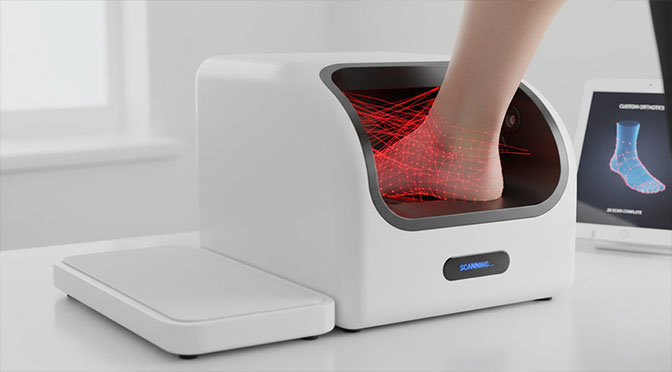
Feet are measured. With millimeter precision. In three dimensions. What is considered medical progress also changes how we perceive the body. Technology makes visible what was previously only felt. It transforms the organic into data. And with the data comes a new question: How does measurement affect our erotic perception? How does our view of feet change when they suddenly become perfectly quantifiable?
Why were 3D foot scans developed?
Originally, it was about pain. About misalignments. About people who couldn’t stand properly. 3D foot scanners were developed for orthopedics to produce custom-fit insoles. The technology was intended to heal, not seduce. Modern scanners work with laser beams or structured light. They project light patterns onto the skin. Cameras capture the contours. In a few seconds, a digital image of the foot is created. Every arch is documented. Every bunion is measured. The height of the arch is determined to within a tenth of a millimeter. The result is a three-dimensional model that can be rotated and zoomed as desired. A foot becomes a data set. The physical becomes calculable.
This precision serves a clear purpose. Orthopedists can accurately diagnose misalignments such as flat feet, splay feet, or hollow feet. Orthopedic shoe technicians construct insoles that provide optimal support for the foot. Shoe designers develop models that fit anatomically perfectly. The technology promises freedom from pain. But it does something else as well. It changes the way we view the body itself.
The scene: Lisa at the medical supply store
Lisa is 26 years old. She works as a graphic designer. For months, her feet have been hurting after long days at work. Her family doctor has referred her for orthopedic insoles. Now she is standing in a bright room at the medical supply store. The walls are white. Various models of insoles are displayed on a shelf. In the middle of the room is a strange device. It looks like a small platform with a transparent surface. A bluish light shines underneath it. The orthopedic technician, a woman in her forties with short gray hair and black glasses, explains the procedure to her.
“Please take off your shoes and socks,” says the technician. “Then stand with one foot on the platform. Stand normally, as you always would.” Lisa nods. She sits down on the chair next to the scanner. Her fingers untie the laces of her sneakers. She takes off her shoes. Then her socks. Her feet are narrow. Her toes are long and even. The second toe is slightly longer than the big toe. The soles of her feet are light in color. There is slight calloused skin on her heels. Her nails are cut short and unpolished. She is not wearing any rings on her toes. Her skin is smooth, except for a small scar on her left ankle. A fall from her bike, years ago.
“Right foot first,” says the technician. Lisa stands up. The floor is cool under her bare soles. She steps onto the transparent platform. The surface feels smooth. A little slippery. “Try to distribute your weight evenly,” says the technician. Lisa concentrates. She feels her toes spread slightly. She feels her heel pressing into the platform. The technician presses a button. A soft humming sound. The blue light under the platform moves. It travels from her heel to her toes. Stripes appear on her skin. Lisa looks down. The lines of light run across her foot like contour lines on a map.
“It only takes a few seconds,” explains the technician. Lisa watches the process. She has never looked at her feet so closely. Usually, she only sees them from above. In the shower. When painting her nails. Now, through the glass of the platform, she sees the underside. The arch of the foot. The pressure points under the ball. The way the little toe tilts inward. “Done,” says the technician. “Now the left one.” Lisa switches feet. Again, the humming. Again, the moving lines of light. Then it’s over.
The measurement: when the foot becomes a data model
“Take a look here,” says the technician. She turns the screen toward Lisa. A 3D model appears on the monitor. It’s her feet. But they look strange. Not like body parts, but like sculptures. The software shows them in different colors. Red marks high pressure points. Blue shows areas with less pressure. Green is in between. Lisa sees immediately: her right foot has more red under the forefoot. The heel is almost entirely blue. “You put a lot of pressure on the forefoot,” explains the technician. “The arch of the foot is slightly lowered. Here.” She points to a spot on the model. She rotates the image with the mouse. Now Lisa sees her foot from the side. The curve of the arch is flatter than she thought.
The technician clicks through different views. From above. From below. From both sides. She zooms in. Suddenly, the toes are huge. Lisa sees details she never noticed before. A tiny asymmetry in the big toe. The way the second toe turns slightly to the left. “Your feet are anatomically very well shaped,” says the technician. “It’s just that the load is uneven. We can compensate for that with insoles.” Lisa nods. But she’s hardly listening. She stares at the screen. At this strange, digital image of herself.
Something has changed. Before, her feet were just there. They carried her. They hurt sometimes. They looked okay in sandals. Now they are measured. Quantified. The software displays exact values. Length: 24.3 centimeters. Width at the ball of the foot: 9.1 centimeters. Height of the arch: 2.8 centimeters. Every millimeter is recorded. Every curve documented. The foot is no longer an organic form. It is a model. A collection of data points.
The change: when perfection becomes visible
In the days after the scan, Lisa keeps thinking about the image on the monitor. She looks at her feet differently. During yoga, she suddenly pays attention to how she distributes her weight. She remembers the red dots in the scan. She tries to shift more weight onto her heels. In bed, in the evening, she looks at her toes. She remembers the enlarged view. The perfect curves of the digital model. Her real feet suddenly seem inaccurate. A little chaotic. Her little toe is crooked. The skin has tiny cracks on her heel. The arch looks higher from the outside than it did in the data.
This new perception is ambivalent. On the one hand, Lisa feels enlightened. She now understands why her feet hurt. The data gives her control. She can make specific changes. The insoles will help. The technology promises improvement. On the other hand, there is a feeling of loss. Her feet used to be just her feet. Now they are flawed. Not perfect enough. The digital model shows her how they should be. But they are not. The measurement has created a standard. And measured against that standard, her feet are deficient.
Sometimes Lisa thinks about how the technician rotated the model. How easily she could zoom in. How precisely every detail became visible. She wonders: Would she want to show her feet to someone who can see them so clearly? The idea is strange. Feet are intimate, even if they are often overlooked. Being barefoot means vulnerability. But vulnerability always had something natural about it. Now there is the perfection of data. The cool precision of measurement. And suddenly, the organic feels like a flaw.
The cultural-critical perspective: Eroticism in the age of measurement
What does it mean when bodies are measured? 3D scanning technology is not neutral. It changes how we perceive physicality. The traditional erotic view of feet has always been subjective. It was based on suggestion. On the interplay between concealment and revelation. A bare foot in sandals could be exciting because it was only partially visible. Because the imagination had to fill in the rest. The aesthetics lay in the approximate. In the curve that one could guess at. In the instep that showed through the skin.
3D scans make everything visible. They leave no room for suggestion. Every millimeter is captured. Every curve is documented. The foot becomes transparent. And with this transparency, something disappears. The mysterious gives way to the measurable. Imagination is replaced by data. Where there used to be imagination, there is now precision. This fundamentally changes erotic perception. A foot that is completely known loses its appeal. Attraction often lies in the hidden. In the not-quite-visible. In the space between knowledge and intuition.
At the same time, technology is setting new standards. When feet can be measured, the idea of a perfect foot implicitly arises. The software shows deviations. It marks areas in red that are under too much strain. It shows in blue where there is too little pressure. These color codes are meant to be medical. But they seem judgmental. Red means: something is wrong here. Blue means: something is missing here. Green is the ideal. The optimal condition. This is how subtly an aesthetic judgment is established. The perfect foot is one that glows evenly green. One that has no misalignments. One that conforms to the norms.
This standardization has consequences. It influences how people see their own bodies. Lisa never thought her feet were problematic. Until the data told her so. Now she sees them differently. More critically. More measuredly. The scan has introduced an objective view. And this view is difficult to ignore. It takes root. It changes self-perception. A body part that simply existed becomes a body part that is evaluated.
This shift is significant in erotic literature. Authors who write about feet traditionally work with suggestion. They describe the curve of an instep. The feeling of sand under bare soles. The way toes curl in sleep. These descriptions are sensual because they are incomplete. Because they stimulate the imagination. Measurement, on the other hand, is totalizing. It leaves nothing out. It makes everything explicit. And explicitness is not always erotic. Sometimes it destroys the very thing that triggers desire: mystery.
The tension between technology and sensuality
But there is another side to the story. Perhaps measurement creates new forms of intimacy. Perhaps it is precisely the precision that fascinates. The thought that someone knows every millimeter. That nothing remains hidden. That can be frightening. But it can also be exciting. Complete visibility as the ultimate vulnerability. The knowledge that the other person can see everything. Every asymmetry. Every imperfection. And yet still desires you.
This dynamic is well known in BDSM culture. Control over information is power. Whoever has the data has knowledge. Whoever allows themselves to be measured reveals something. Measurement becomes a symbolic act. A gesture of submission or trust. “I’ll show you everything. I’ll let you know everything.” This can be intense. It shifts the balance of power. The measured body is transparent. The measuring gaze is privileged.
In Lisa’s case, the technician was the one doing the measuring. She had the knowledge. She could rotate the model. Zoom in. Interpret Lisa’s feet. Lisa was passive. She stood there. Let it happen. Felt the lines of light on her skin. It was a strangely intimate moment. Not sexually, but physically. The technician did not touch her feet. But she saw them more closely than most people have ever seen a foot. This gaze was penetrating. It revealed something that normally remained hidden. The inner structure. The invisible architecture of the body.
For authors: Measurement as a literary motif
How can you use this tension in your prose? The measurement of the body is a powerful motif. It stands for control, for knowledge, for power. It can be threatening or liberating. It can create distance or deepen intimacy. Here are some approaches for incorporating the theme.
First: Use the contrast between analog and digital perception. Let your character feel their feet first. The warmth of the floor. The texture of stone or sand. Then introduce the measurement. Show how perception shifts. From feeling to data. From subjective to objective. This contrast can create tension. It can show how technology changes the experience of the body.
Second, play with the power of information. Who has access to the data? Who is allowed to see the 3D model? Who can rotate, zoom, interpret it? These questions are not just technical. They are erotic. In a sense, the measured body belongs to the person who owns the data. This can establish a power dynamic. A figure that allows itself to be measured relinquishes control. A figure that measures takes control. Use this.
Third: Describe the aesthetic ambivalence. The digital foot is perfect in its precision. Smooth. Symmetrical. Flawless. The real foot is imperfect. It has scars. Asymmetries. Calluses. This tension between the ideal model and real physicality is fruitful. It can create insecurity. Or acceptance. Or both at the same time. Let your characters wrestle with this contradiction.
Fourth: Use the sensuality of the technology itself. The scanner is not a neutral tool. It has its own aesthetics. The blue light. The wandering lines. The humming of the device. These details can be erotically charged. Not despite their technicality, but because of it. Cold precision can be appealing. It can form a counterpoint to the warmth of the body. This contrast is charged with tension.
Fifth: Consider what comes after the measurement. The data now exists. It can be stored, shared, analyzed. It is permanent. A foot changes over time. The digital model remains. It preserves a moment. This temporality is interesting. What does it mean when someone has a perfect image of your body? An image that could outlive you? This is both voyeuristic and archival. A form of immortality. Or surveillance.
Writing Prompt
Your protagonist has her entire body measured for a scientific study. Not just her feet, but her entire body is scanned. She is given access to the data. For the first time, she sees herself in perfect digital precision. Write the scene in which she looks at the 3D model of her body. What does she discover? What surprises her? How does her self-image change? And then: she learns that someone else also has access to this data. Someone who desires her. How does she react? Does she feel hurt? Excited? Both? Explore the ambivalence between vulnerability and power, between shame and pride. Don’t let technology be just a backdrop, but an active part of the erotic tension.