
Pinterest feels like a quiet room. White background. Clean tiles. No arguing. No politics. Just “inspo.” That calm is part of the power. A moodboard sorts bodies before you even form a thought. It shows you what kind of waist is “right,” what kind of legs are “allowed,” what kind of breasts are “too much,” what kind of skin counts as neutral. You don’t only scroll images. You scroll norms. And you often notice it only when your own body starts resisting the frame.
Aesthetics is not a harmless hobby. It is instruction. It tells you what desire should look like. It tells you how shame should feel. And it wraps both in the same pose: casual, natural, effortless. That effortlessness is rarely real. It’s lighting, angles, hunger, filters, and a public that doesn’t applaud but saves.
Why “clean girl” and “coquette” are body politics
“Clean girl” sells control as nature. Smooth skin. Smooth hair. Smooth surfaces. A face without pores, as if it’s never been hot. A stomach without folds, as if it never sits. A body that looks like it has no digestion. No sweat. No pimples. No razor bumps. No underwear marks. No friction. This aesthetic is not neutral. It trains you to hide basic body functions. And it ties worth to being unremarkable.
“Coquette” looks playful, but it is just as strict. Bows. Lace. Pastel. A mouth glossed to shine. A skirt that sits high. A gaze that pretends it knows nothing. It’s a role with rules. It demands a specific kind of innocence that is simultaneously sexualized. You’re supposed to show skin, but act like you didn’t notice. You’re supposed to reveal legs, but without claim. You’re supposed to suggest breasts, but not own them. That tension isn’t “cute.” It’s discipline.
Both trends run on the same mechanism. They make desire measurable. They make shame personal. If you don’t fit, it’s framed as your fault. Not the grid. Not the feed. Not the camera. Your belly. Your chest. Your hips. Your skin. Pinterest then offers “solutions.” Routines. Outfits. Fixes. Body politics as a shopping list.
Erotic literature between trend and resistance
Erotic writing sits right inside this machine. It can reproduce trends without meaning to. A text that always desires the same silhouette is still co-authoring the moodboard. A text that insists on “effortless” while the character is tightening and managing herself betrays that character. A text that treats shame as a law of nature makes the feed invisible.
Resistance doesn’t start by banning trends. It starts by showing them as a stage. You can make the body visible as something framed and compared. You can show that evaluation is in the room even when no one is. The audience lives in the phone. In memory. In the fear of screenshots.
This doesn’t mean erotic writing has to turn into a lecture. Often it gets hotter when you refuse to smooth the power dynamics away. When you show a character feeling desire while also being checked. When you show arousal rising while shame sits at the edge of the bed like a witness. Or when you show shame turning into desire because the gaze of others has been learned as threat.
A feminist erotic text can be explicit and intense. It just needs to be honest about who is directing the scene. The character. Or the feed.
How to expose aesthetics on the page
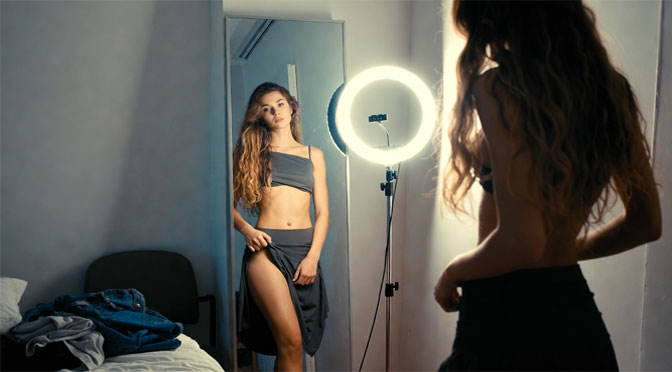
Picture a sorority pledge trying on an outfit for a photoshoot. The room is small. A mirror. A chair. A ring light that makes everything look cold. On the bed lies a stack of clothes sorted by “vibe.” She pulls the skirt up first. It ends high on her thigh. The waistband sits tight over her hip bones. Then the cropped top. It leaves her stomach bare down to her navel. When she raises her arms, the fabric stretches over her ribs. Under the skirt she wears a pair of panties. The line presses into her skin at the edges. A pale ridge under the fabric. Not nothing. Not invisible. Only controllable by even more control.
She looks at herself and realizes something that doesn’t sound like fashion. She isn’t just putting on clothes. She is putting on a gaze. She is placing her body on a track. Keep the belly flat. Roll the shoulders back. Position the breasts so they sit in the neckline. Turn the knees slightly inward because it reads “soft.” Keep the lips a little open because it reads “innocent.” She didn’t decide this in a meeting. She saw it. Thousands of times. Pinned. Saved. Repeated. And now she’s performing it.
Her phone lies next to the mirror. A board is open, named “Rush.” On it are girls in almost the same skirt. The same distance between hem and crotch. The same pose that avoids showing the underwear line while teasing the possibility of it. She notices her hand moving automatically to tug the hem two centimeters lower. Not because she’s cold. Not because she believes in modesty. Because she can already hear the comment. A comment nobody has typed yet. But she knows the shape of it.
This is how you expose aesthetics in prose. Not by naming theories. By writing the inner mechanics. By letting the character feel what her stomach becomes when it might be watched. By letting her notice how her nipples react under thin fabric because the light is cold and the room is quiet. By letting her register how the panty line isn’t just fabric, but a marker: this is where judgment begins.
And then you give her agency back. Maybe she takes a photo and watches the ring light blur her skin into a surface. Maybe she deletes it because it doesn’t match the board. Maybe she keeps it for exactly that reason. Maybe, later in the shoot, she decides not to “fix” the underwear line. Not as a performance of invulnerability, but as a small sabotage of the grid. The body is there. With edges. With pressure marks. With breath.
Moodboards aren’t harmless. They are scripts. And you decide whether your text copies them, or makes them visible.