
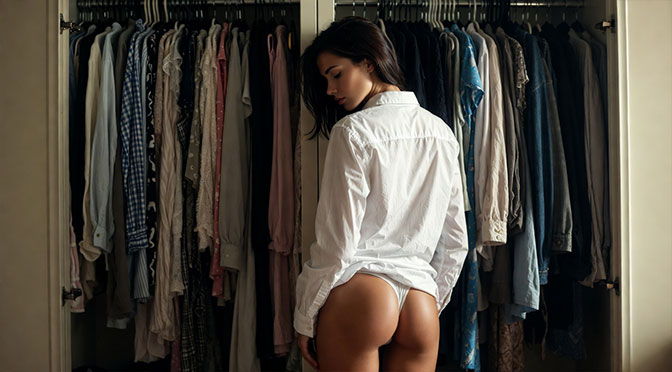
Whether we love them, train them, or simply accept them, the buttocks are not only a functional part of the body, but also a symbol of beauty, strength, and individuality. In this article, we take a look at the different buttock shapes, how you can influence the shape of your buttocks through lifestyle changes, and how they are described in literature.
What butt shapes are there?
Every butt is unique, but experts often divide them into five common shapes. This classification is based on factors such as pelvic position, fat distribution, muscle mass, and genetics.
The round butt (apple butt)
He couldn’t take his eyes off her butt, which glistened naked in the soft moonlight like a ripe fruit just waiting to be picked. His hands slid over the perfect, firm curve, feeling the warmth and firmness that sent him into a frenzy of desire as she arched under his touch and let out a soft moan. In that moment, her apple butt was the center of his world, a symbol of pure seduction that drove him to dive deeper into her and fill the night with passionate kisses.
The inverted heart butt
She stood in front of the mirror, naked and alone, admiring the shape of her butt, which widened from her narrow waist, a curve that enveloped her femininity like a secret. She ran her fingers over the gentle swellings, feeling the soft skin tremble under her touch, and imagined how it would look in the arms of a lover—irresistible, inviting, a heart beating with ecstasy. In her erotic fantasies, this shape became her weapon of seduction, making her powerful and desirable, ready to surrender.
The A-shaped butt (pear-shaped butt)
On the sunny promenade, heads turned as she walked by, her butt accentuated in tight shorts—narrow at the top, wider at the bottom, in a voluptuous pear shape that radiated natural sensuality and aroused fantasies of hidden pleasures. The men whispered to each other about how those curves must sway beneath the fabric, naked and inviting, a cushion of temptation that promised stability and pure femininity. In the crowd, she became a muse, her pear-shaped bottom a silent call for adventure that charged the air with unfulfilled desire.
The V-shaped buttocks
During a girls’ night at the spa, they giggled as they gazed at her bare buttocks in the steam of the sauna room—wide at the top of the pelvis, narrower at the bottom, an athletic sculpture that testified to strength and hormonal elegance. “That’s pure dominance,” whispered a friend as she studied the lines that looked as if they had been carved, inspiring fantasies of wild nights in which this shape triumphed in passionate embraces. In their circle, the buttocks became a topic of conversation, an erotic secret that mixed envy and admiration, and they dreamed together of lovers who would revel in this powerful silhouette.
The rectangular butt (square butt)
He pulled her toward him, naked and breathless, and cupped her butt, whose straight lines from hip to thigh offered a box-like firmness that turned into waves of pleasure when touched. His fingers dug into the malleable skin, shaping the neutral contours into something wild and erotic, while she pressed herself against him and he discovered the subtle seduction in her straight lines. In the heat of the night, this square shape compensated for any missing curves with intense closeness, a cushion of ecstasy that drew him deeper into her world and broke through the boundaries of passion.
How can I influence the shape of my butt?
The basic shape of your butt is genetically determined, but you can tone, enlarge, or reduce it through targeted measures. The key lies in a combination of training, nutrition, and lifestyle. Here are some practical tips:
Training and exercises:
Focus on the gluteus muscle (the large buttock muscle). Regular strength training can make your buttocks rounder and firmer.
Squats:
Works your buttocks and legs – start with 3 sets of 10–15 repetitions.
Glute bridge:
Lying on your back, lift your hips to keep your buttocks firm.
Kickbacks:
Get on all fours and extend one leg backward—ideal for targeted shaping. Train 2–3 times a week to build muscle. Interval training (e.g., running or climbing stairs) helps burn fat.
Nutrition:
To reduce fat, aim for a calorie deficit (eat less than you consume). You need protein to build muscle. Eat protein-rich foods: chicken, fish, eggs, nuts, and legumes. Reduce sugar and processed foods; incorporate plenty of vegetables and fruit. Drink plenty of water and eat balanced meals – don’t starve yourself, as this destroys muscle!
Other factors:
Reduce stress (it promotes fat accumulation), get enough sleep, and incorporate everyday exercise. For older women, hormone balance (e.g., through medical consultation) can help.
Patience is key—results will show after 4–6 weeks.
Remember: it’s about health, not perfection.