
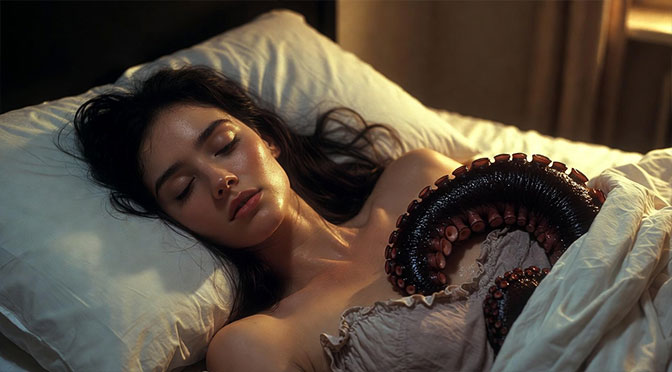
Tentacles—those serpentine, multi-armed structures from the realm of sea creatures or fantastical beings—have played a fascinating and often controversial role in literature. From a psychological perspective, they represent not only the unknown and the unfamiliar, but also deep desires for submission, multiple stimulation, and the transgression of social taboos. In this blog post, we take a look at the origins of this motif, its development in manga and hentai, and its presence in contemporary erotic and romance novels. We analyze why tentacles can be so psychologically appealing: they often symbolize a form of total surrender, in which humans relinquish control to something more powerful and inhuman, touching on themes such as power dynamics and sexual fantasies.
The historical origins: From folklore to erotic art
The roots of tentacles in literature and art go back a long way in Japanese culture to the Edo period (1603–1868). Tentacles first appeared as an erotic element in the shunga tradition, a form of erotic woodblock prints. Early examples can be found in works such as Kitao Shigemasas’ Programme of Erotic Noh Plays (1781) or Shunshō Katsukawas’ Lust of Many Women on One Thousand Nights (1786), where women are ensnared by octopuses.
These depictions were based on ancient folklore myths, such as the legend of the Ama divers (pearl divers), who came into conflict or ecstasy with sea creatures. Psychologically, these motifs reflect a fascination with the “other”—the sea as a symbol of the unconscious, where hidden desires rise to the surface. Sigmund Freud might see childhood traumas or phallic symbols here, while modern psychology points more to the exploration of boundaries and catharsis through fantasy.
The most iconic work is Katsushika Hokusai’s The Dream of the Fisherman’s Wife (1814), a woodblock print from the book Kinoe no Komatsu, depicting a woman being sexually stimulated by two octopuses. In the Japanese context of the Edo period, this was interpreted as consensual and pleasurable, not rape, as it is often misunderstood in the West.
From a psychological perspective, this embodies a fantasy of total envelopment: tentacles allow for multiple touches at once, suggesting a longing for overwhelming sensory stimulation. It is about the dissolution of the self in ecstasy, a form of submission that has its roots in BDSM-like dynamics.
The evolution in manga and hentai: Circumventing censorship and exploring taboos
In modern Japanese literature, especially in manga, tentacles experienced a boom in the 1970s and 1980s. Toshio Maeda, often referred to as the “tentacle master,” created SEX Tearing in 1976, an experimental short story that introduced tentacles.
His famous work Urotsukidōji (1986) and later adaptations made tentacles a hallmark of the hentai genre. The reason? Japanese censorship laws prohibited the depiction of penises, so Maeda replaced them with tentacles or robot arms to show penetration.
Psychologically, this allowed for the safe exploration of dark fantasies: tentacle monsters embody the monstrous, the uncontrollable, and allow themes such as rape fantasies or dominance to be addressed without promoting real violence.
From a psychoanalytical perspective (e.g., according to Freud and Lacan), tentacles serve as fetish objects that compensate for fears of castration or loss of control.
They represent a “monstrous sexuality” that transgresses social norms and explores identity fluidity—especially at a time when gender roles in Japan were changing.
For many readers, such stories offer catharsis: the fantasy of tentacles as “perfect lovers”—multi-armed, tireless—appeals to desires for multiple fulfillment that are impossible in reality.
Current erotic and romance novels: From monster love to inclusive fantasy
Today, the tentacle motif has shifted to Western erotic and romance literature, often in indie publications and on platforms such as BookTok. Books such as Tentacle Entanglement by Siggy Shade or Hook, Line, and Tentacle by various authors combine sci-fi elements with romance: aliens or mythical creatures with tentacles become lovers who court human protagonists.
In the “monster romance” genre—popular among women and LGBTQ+ people—tentacles serve as a symbol of acceptance of the “other.” Psychologically, the attraction can be explained by the idea of a protective, overpowering partner who is loving despite their monstrosity.
It’s about exploring identity: tentacles allow for imaginative scenarios in which gender and species boundaries are dissolved, which is particularly liberating for marginalized groups.
Examples such as Wriggle and Sparkle by Megan Derr or The Klockwerk Kraken Collection by Aidee Ladnier depict consensual relationships where tentacles are not only erotic but also emotionally connecting.
From a psychological perspective, this reflects a modern longing for diversity: in a world full of uncertainties, tentacles offer a metaphor for comprehensive embrace – literally and emotionally.
Tentacles as a mirror of the psyche
From ancient shunga prints to manga to contemporary romance novels, tentacles tell a story of the human psyche: they embody the desire for the forbidden, the fascination with the monstrous, and the search for total fulfillment. Psychologically, such fantasies help to process fears and push boundaries without real risks. In an age where sexuality is becoming more diverse, tentacles remain a powerful symbol—proof that literature helps us explore the unconscious.
More on this topic:
https://manther.de/en/2024/01/alien-parasites-das-aufsteigende-fantasy-element-in-der-erotischen-literatur/