
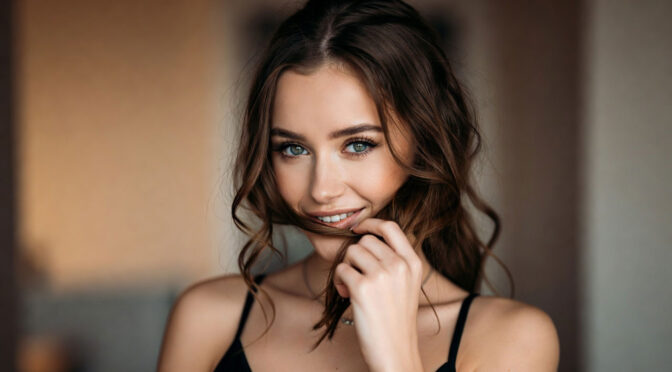
Hair is more than mere keratin fibers – it functions as cultural signaling, psychological projection surfaces, and in literary contexts, powerful erotic symbols. In erotic literature, hairstyles serve as versatile metaphors that extend far beyond pure aesthetics, creating deep psychological resonances.
The Psychology Behind Hair Symbolism
Human fixation on hair has evolutionary biological roots. Full, lustrous hair historically signaled health and fertility. Yet the erotic charge of hairstyles goes deeper, touching on questions of control, identity, and transformation.
Psychoanalyst Charles Berg described hair in the 1950s as a secondary sexual characteristic with strong libidinal investment. Hairstyles become nonverbal communication tools, revealing social belonging, personality, and sexual availability without a word being spoken.
The Tight Braid: Control and Its Dissolution
The meticulously plaited braid frequently symbolizes order, self-control, and social conformity in erotic literature. The severity of a ballerina’s bun or a military-precise French braid speaks of discipline and restraint.
The true erotic tension, however, emerges in the moment of dissolution. When fingers open the plaits, hair ties are removed, and carefully tamed hair cascades in waves, literature stages a liberation. This physical transformation becomes a metaphor for emotional and sexual disinhibition – the transition from the socially acceptable to the forbidden, from the controlled to the uncontrollable.
In this narrative lies a timeless fascination: the person who radiates control in daily life reveals their untamed nature in intimacy. The braid becomes a symbol of this duality.
The Bun: Professionalism and Hidden Sensuality
The bun – upswept, elegant, functional – codes professionalism and inaccessibility. In office environments, academic contexts, or formal settings, it signals: “I am here for serious matters.” This hairstyle creates distance and establishes boundaries.
Precisely this distance makes the bun so literarily compelling. It contains the promise of the concealed. What happens when this carefully constructed facade falls? The loosening of a bun often becomes a ritual act in erotic texts, marking a transgression – from professional to personal, from public to private.
The psychological effect relies on contrast: the stricter the external appearance, the more intense the imagined transformation. The bun promises hidden abundance, a secret dimension of personality accessible only to select individuals.
Open Curls: Naturalness and Untamed Vitality
Curly, loose hair culturally represents naturalness, spontaneity, and a certain wildness. While sleek, structured hairstyles demonstrate human control over nature, curls represent the organic, the untamed – those aspects of human existence that cannot be fully rationalized.
In erotic literature, curls are frequently associated with passion, impulsivity, and sensual presence. They move independently, fall into faces, require brushing back – they create constant opportunities for physical interaction. This dynamism makes them literarily valuable: curls generate moments of touch and bodily contact that integrate organically into scenes.
Moreover, curls convey an aesthetic of authenticity. In a culture that prizes perfection and control, they signal: “I accept myself in my natural form.” This self-acceptance becomes unconsciously linked with sexual openness and emotional availability.
Hairstyles as Narrative Tools
For authors of erotic literature, hairstyles offer subtle possibilities for characterization and plot development. The transformation of a hairstyle can mark turning points, visualize emotional states, or illustrate power dynamics.
A protagonist who exchanges her usual updo for loose waves signals change without explicit explanation. A character who obsessively interacts with another person’s hair reveals desire through action rather than declaration. The bodily intimacy of washing, combing, or styling hair creates scenes of great tenderness or dominance – depending on context.
Cultural Codes and Individual Variation
It remains important to recognize that hair symbolism is culturally coded. What represents innocence in one context (such as two braided pigtails) can be highly erotic in another. Meaning emerges from the interplay of cultural context, individual characterization, and narrative staging.
Good erotic literature consciously plays with these codes, subverting expectations or deliberately reinforcing them. It uses the psychological resonance of hairstyles without falling into crude stereotypes.
Conclusion: The Poetry of Transformation
Hairstyles function as erotic metaphors because they make transformation visible – and transformation is the heart of erotic tension. The moment when someone loosens their hair, reties it, or allows it to be touched by others is a moment of vulnerability and openness.
In erotic literature, these physical gestures become symbols for inner processes: for removing masks, for building trust, for surrendering to desire and passion. Braids, buns, and curls tell stories – of control and freedom, of concealment and revelation, of the multifaceted nature of human intimacy.
For authors of erotic texts, it is worthwhile to master this subtle symbolic language. Because sometimes the most intense eroticism lies not in the explicit, but in the delicate gesture with which a hairpin is removed and everything changes.